Thursday, May 24, 2012

Wanna go out and hold a beer with me sometime?

We've talked a lot in class about what's acceptable for men, and what's acceptable for women. As I contemplated what to compare in advertising in this blog post, and my current stress load, all roads lead back to drinking. 
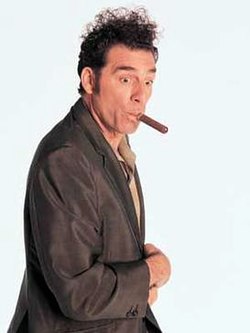
I was going to post a picture of myself, but then I couldn't ever show my face in class again. Close enough.
Drinking is, of course, one of the greatest, most forbidden acts when under 21, and a regular feature in most tv shows and movies. Being teased for ordering "girly" drinks is something I know I've seen on both Scrubs and How I Met Your Mother.
"Oh poor me! I get to order yummy pink drinks with chunks of real fruit that guys secretly like but can't order because they'll be made fun of!"
I decided to narrow down my search to beer drinking, the manliest of cheap drinking. As I googled images, I wasn't terribly surprised there was a difference between photos of men and women, but I was surprised that even the stock photos reflected that difference. I thought I'd be greeted by german barmaids and hooters tank-tops, but the stock photos were set up in the same basic way. With one major difference.

Business men don't use solo cups #swag
In almost every photo, the man is seen just drinking his beer. The woman, however...
When my female friends and I drink together, we just like to hold each other's beers for extra excitement!


And again:
I definitely typed "drinking" not "holding coyly"

I thought maybe I'd expand to see what women look like drinking whiskey, the manliest hard alcohol ever, next to scotch.
"I'm savoring the flavor!" said no one, ever. 
I got this when I looked up scotch. Evidently, women don't like to be photographed drinking scotch. 
There it is. Far more accurate.
Every picture of a woman drinking seems to focus more on her face and how she's looking. The pictures of men aren't supposed to be sexy. And none of them are looking directly into the camera. Most of the women's photos are.
Except for this guy. He's breaking gender norms!
Even the males infants photographed with beer bottles weren't facing the camera. Not surprisingly, the focus remains on a woman's appearance, and a man's actions, even when taking part in something designed to make a person lose control of inhibitions. How deep does our gendered society go?

Future solo cup user... 

Credits:
It's Always Sunny In Philadelphia 
How I Met Your Mother: Screencap: Season 2, Episode 10: "Single Stamina"
Woman Drinking Whiskey for real


Monday, May 21, 2012

Books and Toys

            My mother was always one for reading when I was a child. I used to spend hours reading to myself or my youngest brother, who much to his dismay did not possess my unholy talent for reading The Very Hungry Caterpillar. I had a lot of favorites, but one that sticks out is the 1985 book Jillian Jiggs. I know my mother’s intentions in giving me that book were to trick me into cleaning my room. The story of this little girl is essentially that she constantly goes from activity to activity, without cleaning up after herself. As the oldest child, I think my mother thought that my brothers would follow my shining example (inspired by the book), if only I would opt to lead as a shining example instead of as a chameleon on crack. But I digress. Jillian Jiggs tells a story of a little girl who doesn’t seem to gender conform (she dresses up as a robot, a witch, a tree, a wild monster, etc) but her mother does fill the gender role of being the parent who stays home and disciplines/cleans up after the children.  Surrounded by my Star Wars action figures, I would read Jillian Jiggs, and concoct a new assortment of adventures and messes for my brothers and I to make. The power of the written word!
These may as well be in the photo album for my childhood. They only need more batman and glitter.

          My Star Wars toys were held in a far higher regard than my Barbies, but Barbie came with far more accessories that could be turned into the interior of the rebel base (complete with pink kitchen and hot tub), or stockpiled as supplies against the Empire, so I played with both. I know Star Wars wouldn’t pass the Bechdel test, but those action figures remain my favorite, even above my batman toys. It was cool, to my brothers, that a girl could play with “boy” toys… I don’t know what magic barrier there was, but I took pride in that sense of doing something that most girls wouldn’t do. As I looked for specifically gender non-conforming books, I remembered a year or two ago seeing one called My Princess Boy, a book a mother wrote for her son, who loves to wear dresses and princess style attire. Cheryl Kilodavis tells the story of her child differences in a society that puts a huge amount of pressure on gender conformity. The majority of the ratings on Amazon for the book are positive, with only 3 of 34 giving any negative feedback, two lamenting it wasn’t a good enough children’s storyline, and one complaining that the story is a gateway to complete delinquency.
"This book is [sic] a great reading material for parents with destructive and criminally-inclined children, because it teaches that no matter what a child grows into it is stil "OK""- Teapot Tales, Amazon.com
            The idea behind My Princess Boy is acceptance of other people as individuals, as unique, in their gender non-conformity or other differences. When I looked for a gender neutral or non-gender conforming toy, I was hard pressed to find anything. Every time I thought I found something, I would realize it was a “boy toy” covered in pink, because girls can only play on pink drum sets and pink guitars. I thought I’d finally found some in the lifestyle toys… then I looked at pictures.
You know it's a boy because he's got a blue shirt. Also, he's driving. 
First I spotted a “Mighty Wheelz” car, which was placed in the 3-7 age category. Then I remembered I was looking for a “girl” toy that was made “boy” friendly. I kept looking through cars. 
She's got her "Passenger's side pink!" shirt on. Ken's got super powers, so he can still drive the car even though it's pink. Must be in the blue shirt. Way to take one for the team, Ken!
I spotted the Barbie and Ken jeep, which depicted Ken driving Barbie’s jeep, just as the little boy is depicted driving the Mighty Wheelz jeep with a little girl riding in the passenger seat. Also, decidedly a girl's toy because of the Barbie/pink association. 
Teaching children of more than one gender to get back in the kitchen!

The next best thing I could find was a kitchen set, much more advanced looking that the one I played with as a child. Kitchen’s are stereotypically girls toys, though in the picture we see both a boy and girl playing with the toy. The little girl is talking on the phone, and the little boy is pretending to cook. While the toy might be showcasing it’s many activities in showing a little boy and little girl playing with different parts, I think it’s telling that the little boy is doing the “work” and the little girl is “socializing” on the phone. Even in gender neutral toys, gender roles are still alive and well. 

Credits:
Books- Amazon.com
Toy photos - ToysRUs.com

Thursday, May 17, 2012

The Hunger Games


Looks like there's about to be a song, but it's not that kind of teen movie...
The Bechdel Test goes as follows:
It Has to Have Two Named Women:
Katniss, Prim, Rue, Effy
Who Talk to each other:
All of these characters interact with Katniss at some point in the film for over 30 seconds.
About something besides a man:
Done. Katniss's life is on the line, she's not trying to get in on some heterosexual love... but somehow, I'm sure it'll sneak up on her anyway. Katniss and Rue spend time developing a friendship and plan. Katniss and Prim discuss the reaping, as well as a tearful goodbye. Effy gives advice and silly "let them eat cake" style conversation, and Katniss gives her mother some tough love. There are conversations about men, but they don't dominate every conversation.
I wouldn't blame her for talking about this guy, though. He's lovely.
Right off the bat, The Hunger Games passes the Bechdel test. Katniss Everdeen is seen having conversations with her mother, her sister, an ally, and her handler, all based around her survival in the games, despite having a love interest involved. What I found particularly interesting about the film and it's relation to gender difference was that it does place a considerable amount of Katniss's success on her own shoulders, complete with her team. However, what ends up setting her ahead of her competitors seems to be the discovery of, or the illusion of heterosexual love. 
With this guy, and his flawless logic.
While Katniss is resourceful, and brave, and ultimately is the heroine of the story, her edge in the games really comes through after Peeta confesses his feelings during his interview. She's of course blindsided, because as a sixteen year old girl, she's never considered her feelings on love, sex, and relationships with anyone. Also, she's got 23 other kids trying to take her out. She's a little busy. When she is in the woods, toward the end of the games, she teams up with Peeta, and ultimately they both live because of her intelligence. However, without Peeta, it is unlikely Katniss would have survived on her own. His love story won her favor with sponsors, and Peeta saved her from the Career team. 


Still can't save her like hetero love can!
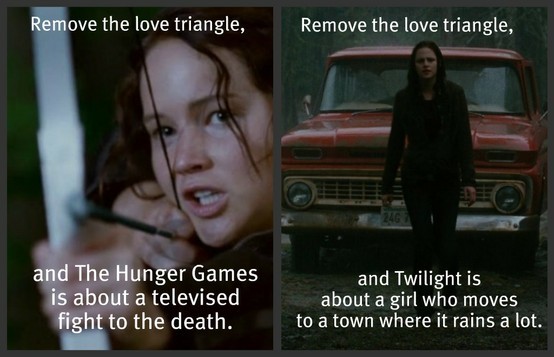
In many popular young adult novels adapted into film, there’s usually some kind of heterosexual love interest. Katniss doesn’t follow the same pattern as Twilight’s Bella. Bella's love interest spends their story trying to convince her why she shouldn't give in to her feelings, while at the same time nurturing dependence and a relationship. Katniss is a different formula, and is the secondary storyline to her survival. She doesn’t fall head over heels for Peeta, she doesn’t spend the film consumed by her love interest, though she is obviously torn between her best friend and her team mate. Peeta spends his time trying to convince her to fall in love. Katniss needs to be tricked into love and sex, because she is naive and pure, as women should be. In Twilight, Edward saves Bella from a speeding car, and in Hunger Games Peeta saves Katniss from starvation as well as from violent interaction with other players. Edward and Bella cannot be together until everything around their unholy union is resolved (something about a vampire war? I don't remember). Ultimately, Katniss cannot commit to Peeta as they are embroiled in a game for their lives, but by the end of the series, she is bound to choose a mate as the turmoil dies down and a new age of peace starts. 


I've lived the story on the right, why would I pay to watch it?


Credits
That's real talk.


Hunger Games
Gale
Peeta
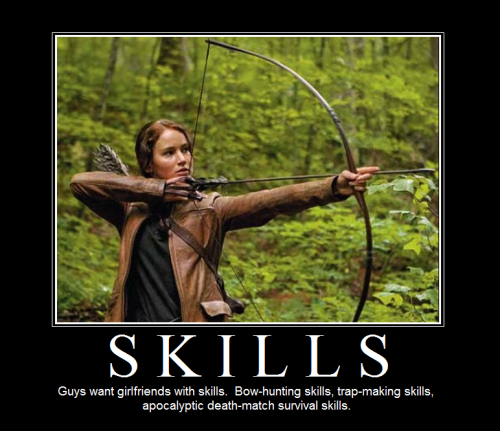
Skills
Katniss vs. Bella
ECards

Monday, May 14, 2012

Wild Ones

Featuring Sia... No? Oh, alright then...
At first listen, Flo-Rida and Sia's "Wild Ones" is a catchy, musically well put together mix that I heard first in one of Pullman's two bars, and downloaded on the drive home (not a proud moment, in retrospect). Watching the video, the eyes are overwhelmed by scenes of sky diving in Dubai, club hopping, parties, and the typical formula for a hit song you'd hear on z100. One might think that a song with a man and woman working together to produce a hit would feature more equal footing, but that's not the world we live in. It's not a new idea that music lyrics are riddled with gender roles, masculine and feminine standards, and complete lack of inclusion for anyone who doesn't fall into a stereotype. Pimps, cowboys, heroin chic "girls" and rockstars, genre doesn't matter, all modern music categories have that "same shit, different bass line" feel to their lyrics. Society and the popular music industry both need some house cleaning if anything is going to change.


Sia leads in with:
Hey, I heard you were a wild one!
If I took you home, it'd be a home run,
Show me how you'll do,
I wanna shut down the club,
With you,
Hey I heard you like the wild ones...

Seems pretty tame. Everyone is a wild one and wants to hook up after the club closes. Fair enough.

"And that, children, is How I Met Your Mother"
But Flo-Rida bursts into his verse with, "I like crazy, foolish, stupid"
Because Flo-Rida is the artist featuring Sia, the song is mainly focused on him, Sia's got a bridge to work with later on, and Flo-Rida dominates the verses. Sia makes no note of what she wants in her "wild one" but Flo-Rida leads in with what he wants, and it's nothing that would put his desired female partner on a level playing field with him or any other man. The song continues, parties bumping and excitement building as he raps:

Take me so high, jumping on clouds, surfing off the ground,
Said I gotta be the man, be the head of my fam,
Mic check 1, 2,
Send 'em down in the club with the playboy girls,
Til they all get loose, loose
Pop the bottle, we all get bent, then again tomorrow
Gotta break loose, cause that's the motto,
The club's shut down, a hundred super models,
(Then it's back to Sia's hook)

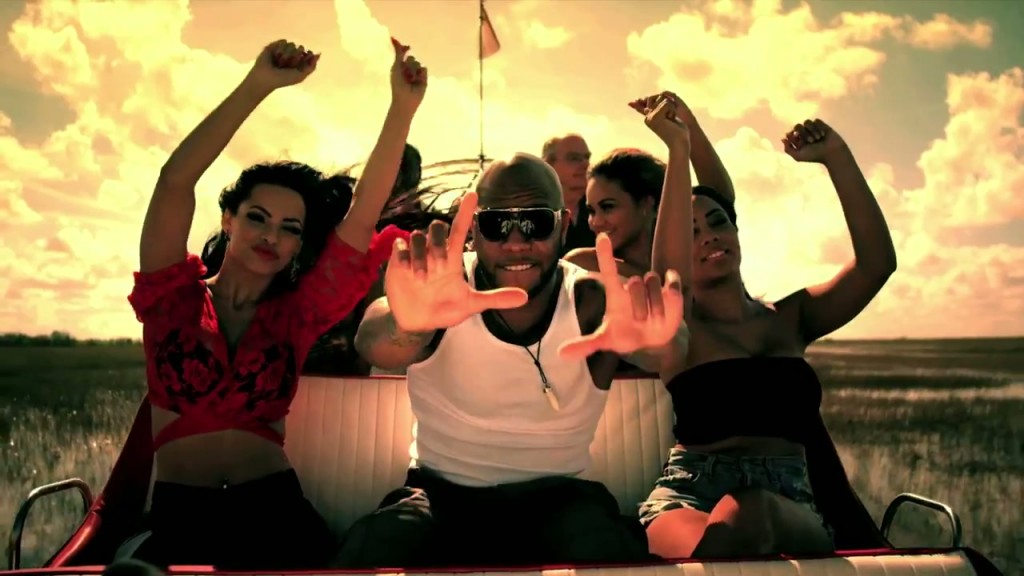
 Cheese!
Flo-Rida is pumped to be partying, but he's still following what he deems women want him to be, obviously. Head of the family, the man, and he's headed to work as the main money-maker, doing his mic check. He's in charge, and since he's the money maker and focus of attention, he can send Sia (or another sexy woman) down to the club with his legion of supermodels and playboy girls. These girls are wild ones, and desirable. The women need to drink. Women need alcohol to be talked into having sex with men. Women who are sexualized for a living are essentially cutting out the middle man of talking women into sex, all they need is alcohol to make the party start, if we follow the stereotype. This song is not about finding "the kind of girl you take home to mom" it's about finding a home-run. Taylor Swift would be S.O.L. Men who are doing as they are supposed to, presenting a masculine front, heading their household, are able command that kind of power, and women will group together in praise of such accomplishment, shutting down the club surrounding Flo-Rida.

He returns with:
Can't see me with ten binoculars,
So cool,
No doubt by the end of the night,
Got the clothes coming off,
Then I make that move,

 
Flo-Rida is the pinacle of masculinity. Who could challenge a man who is so cool he can't be see with ten binoculars? No one, that's who. Flo-Rida has no doubts that the clothes will just fall off his legion of playboy bunnies and:


What happens to that body is a private show,
Stays right here, private show,
I like 'em untamed, don't tell me about pain
Tell 'em this, bottoms up with the champagne,

That body, not that woman. Not that person. That body. Flo-Rida breaks down what's important to him in a woman. He won't tell anyone about the "private show" he's expecting to see (til the next single, anyway). He likes wild, sex crazed women, who are so overcome by his masculinity and raw sexual power, that they won't complain about the rough sex. If the women are drinking enough, Flo-Rida won't have to hear about it anyway. But no reason to be alarmed! Sia is onboard with that afor mentioned bridge, to follow her hook:

I am the wild one, break me in,
Saddle me up and let's begin,
I am a wild one, tame me now,
Runnin' with wolves, and soon I'm on the prowl

I don't think that outfit is very practical...


I think it's fairly obvious that the metaphor Sia is running with initially is that one a horse. Horses are ridden, dominated, captured from the wild and domesticated. The need to be saddled with a man to keep them in check. But she's saying it's ok, giving Flo-Rida permission as though it's what she's in to, she's empowered! The last line hints that she too is aware of the short-lived terms of their relationship, and once she's done running with wolves, she'll be back to looking for her own 'wild one' to break her in again. 

Flo-Rida is game:
Show you another side of me,
A side you'd never thought you'd see,
Turn up that body, dominatrix, til you had enough,
I hear you like the wild stuff,

Poetry. I'm not sure what this other side of Flo-Rida is, that no woman would ever think she'd see... He's been pretty clear that he's a sex god, and the women flock to him for his raw masculine power. It seems as though we're still seeing the same bottle popping wild one with a healthy male sexual appetite that's dominated 75% of the song. It's nice that he seems like he's taking into consideration what his sexual partner is into, based on what he's heard about her. Wild women tend to get the wild reputations, but they don't tend to get that #4 single on iTunes with songs about maximizing their femininity and gender role position. Wild women are horses who need taming, and wild men are the wolves, taking women down, buying them drinks, and domesticating them, dominating them, then moving on to another 'wild one'. A woman's sexuality is never her own, she's always got to be tamed and coerced into having sex.

Good girls don't look for sexual thrills!
What it boils down to for me is that if the roles were reversed, this song would be regarded much like Rihanna's 'S&M' and censored, lauded, and swirled in controversy. Sia would have her sexual history plastered across the paper, and we'd wonder who this sex bomb thinks she is, polluting the airwaves and not thinking of what the children might pick up! But we knew that already, because we see it happen all the time. When women write a song about hooking up, it's a gimmick, but when men do it, it's just another one of the 5 singles they'll release about the exact same subject, and it just might be grammy worthy. 8 of the top 10 iTunes US songs have male-identified leads, while Carly Rae Jepsen's "Call Me Maybe" sits at #2 and JLo's single sits at #7. It'd be great if this song had come through for Sia as a woman on the same level, a woman being empowered. Unfortunately, it stands out because it's catchy, as it will until the next Wild Ones pushes it to the back of the every growing line of Party Rock Anthem's, and anything with the word 'swag' in it. 


Wednesday, May 9, 2012

Privileges


            In thinking about privilege over the last two days, I have been able to identify numerous ways I receive privilege in U.S. Society.
1.             As an able bodied person, I never have to worry about being able to access anything. When I went to lunch a few weeks ago with a friend who uses a walker, it became clear that the restaurant was not completely accessible easily for anyone who isn’t able bodied. The seating was on a step-up style platform; there wasn’t a convenient place for her walker. I can easily maneuver through crowded supermarkets and clothing racks, not worried about getting caught on anything. There is always space for me to sit easily in a classroom, and no one condescendingly offers me assistance on a regular basis. I don’t have to wonder if someone rewarded my hard work because I am “overcoming” something, I can feel confident my hard work as an able bodied person is attributed to me. No one will accuse me of getting ahead because of a disability either, regardless of whether or not it’s true. I am considered capable as a person, ahead of someone who is considered disabled.
2            As a cisgendered woman, I can go to a clothing store and be directed to the appropriate fitting room without issue. I can browse through women’s underwear and women’s clothing without concern or embarrassment, and without anyone staring at me or whispering behind my back. I can purchase make-up, hair products, anything considered feminine, and no one will question my intentions or consider me a pervert, or as doing anything outside of ordinary. I do not have to worry about passing, or even worry about the concept of passing. I know where to go to the bathroom and it is unlikely anyone will question my presence or harass me. I can feel secure in my gender because no one is constantly questioning me, or bullying me based on my appearance. I get to look in the mirror and see a reflection that seems correct and familiar.
3.             As a white person, I can go into a store, fairly certain that if someone is being watched or followed, it’s not me. If I get pulled over by a police officer, I will not have my citizenship questioned; and if I am issued a ticket, it will not be attributed to my race. My voice is more likely to be heard than a person of color’s voice, even if we are speaking about an issue that concerns people of color, and not the voices of white people. When I say I am an American, no one will say to me, “African-American, Mexican-American, Asian American.” It will be accepted that I am an American because I am white. No one will say I got my job just because of my race and affirmative action.  Currently, I subscribe to a cosmetics sample site. In the 3-4 months I’ve been subscribing, I’ve gotten several skin care/foundation samples. All have been for fair to medium complexions, though I have never been asked what color my skin is. I can google search for snarky images, and be sure that most of the results will feature people who represent my group.


ECard

Sunday, April 29, 2012

The FBI is After Me!


The slightly less popular spin-off...
         I was five the last time I saw my grandfather, alive. Every summer he would come from California, bearing gifts of plain donuts, paint-with-water books, and once even a swing set he put together in our backyard. But the year I turned five was also the year he stopped separating reality, and the voices only he could hear. As he walked my twin and I through our neighborhood, played games with us, and listened to our childish babbling, he warned us to steer clear of the FBI, because they had it out for him. "You don't trust the FBI." He would say, seriously. We would solemnly nod our heads, then go back to a high-stakes game of Hi-Ho-Cherry-O. Before he left that final visit, he and my parents fought because he was sure my father had either stolen his Mexican gold, or let someone from the government into the safe to get it.
However, there was no Mexican gold. Ever. There was no government conspiracy. Ever. My retired ironworker grandfather suffered from paranoid schizophrenia, and was found dead as the result of a coronary in an El Paso hotel the year I graduated high school. He wasn't speaking with anyone in the family anymore. Paranoid schizophrenia, according to the DSM, is a disorder that is seemingly triggered by life stressors, such as the start of college or the first full time job. Symptoms can include "delusions, hallucinations, disorganized behavior and/or speech". According to the National Institute of Mental Health, about one percent of Americans have schizophrenia. In my grandfather's case, he suffered from what experts refer to as "delusions of persecution" meaning he was always under the impression that someone was after him. The National Institute goes deeper into the history of schizophrenia, suggesting that is is also linked to genetic disposition. While experts are quick to say a genetic predisposition will not cause the onset of the disorder, genetics need to be considered in preventative treatments, and avoiding environments or stressful situations that can trigger the disorder. There is currently no blood test for a diagnosis with this disorder, though schizophrenia is not by any means a new disorder.

German physician Dr. Emile Kraepelin gave schizophrenia identification as an illness in 1887, but the disorder is believed to have existed long before then.
Initially, he dubbed schizophrenia as an 'early dementia' in order to differentiate from other form of dementia, such as Alzheimer's, which doesn't typically occur until late in life. A Swiss psychiatrist, Eugen Bleuler, introduced the term "schizophrenia" in 1911, only a few years before my grandfather was born. Schizophrenia's greek roots schizo and phrase translate literally into split-mind. Bleuler felt this 'early dementia' required its own category, because unlike most dementia disorders such as Alzheimer's, schizophrenia doesn't always translate into mental deteriorations, and can manifest itself later in life. Schizophrenia was then divided into five categories: disorganized, catatonic, paranoid, residual, and undifferentiated. In addition, men were and still are more likely to exhibit symptoms earlier than women, but diagnosis show a relatively even split between male and female identities. But without more information or treatment available, the label 'schizophrenic' was only treatable through institutionalization, shock therapies, and other forms of psychotherapy.


In the 1950's, four in every one thousand Americans were institutionalized for some form of a 'severe' mental disorder, doubled from the two in every one thousand at the beginning of the century. At this time, my grandfather would have been a man in his early thirties, married to my grandmother, in the throes of raising blended families, and an alcoholic in post World War II California. As doctors and researchers argued genetics versus environment, the only treatment option for a man like my grandfather (had he been aware of the disorder at all) would have been institutionalization, something they no doubt couldn't afford. My grandfather chose the slightly more affordable alternative; alcohol. According to the National Institution of Mental Health, violence is not typical of people who suffer from schizophrenia, but substance abuse is incredibly common. Since the effects of many abused drugs, like cocaine, mirror symptoms of schizophrenia, it is often hard to discern addicts from those suffering psychiatric disorders, especially when a person takes on both roles. My grandfather was a schizophrenic alcoholic, but to society he was merely an alcoholic. No one knew what was wrong with him, and he wouldn't have been able to afford a doctor, nor would he have seen one even if it had been affordable. As we saw in 'Tough Guise', throughout our nation's history we have held our ideal of a man to a high standard, free of both physical and mental imperfections. A Marlboro Man. A Jon Wayne. An industrial laborer, working class or impoverished, with the goal of presenting as masculinely as possible, would never seek to label himself as "sick". With his use of alcohol to self medicate, my grandfather became increasingly agitated and violent toward my grandmother, further deviating his diagnosis from mentally ill to a "chosen" deviance as an alcoholic wife-beater.
He looked a little more like this Marlboro Man, if we're being honest.
Alcohol, while legal, is linked as a cause of almost four percent of deaths worldwide. Road accidents, alcohol poisoning, and liver damage among other issues kill more people than AIDS, and is a causal factor in 60 types of diseases and injuries according to Reuters. Alcohol-related psychosis presents similarly to schizophrenia, though theoretically if the alcohol consumption stops, so will the psychotic episodes, after the withdrawals cease. However, schizophrenics who self medicate with alcohol often develop what is known as Alcohol Use Disorder, which manifests itself similar to alcoholism, but is different in that if the original issue is cured or treated, the alcoholism ceases. Unfortunately, studies have shown that patients with "co-occurring mental and substance use disorders have rarely received needed treatments". This can happen for multiple reasons. Patients with severe mental disorders have already been demoralized and stigmatized, creating reluctance to seek treatment or accept help. Even today, there are still few resources available not only to help schizophrenia specifically, but even fewer are available to help a patient recovering from schizophrenia and Alcohol Use Disorder in tandem. Relapse is common in alcoholics, and in treating a disorder with no cure, relapse is even more likely. But while there are not any sure-fire cures, the development of anti-psychotics has made major strides in the last sixty years of medicine.
It's a very lonely, yet crowded freedom...

As my grandparents were divorcing in America, in Paris, a surgeon named Henri Laborit was attempting to reduce surgical shock in his patients. He was attempting to use another form of anesthesia, trying to calm the brain chemicals that cause shock. He experimented with the effects of antihistamines, and found surprising success with a drug called chlorpromazine (Thorazine, the designer drug name), which calmed even the most violently psychotic or catatonic patients, and "for the first time, we could see that they were sick individuals to whom we could now talk." according to one physician. In 1954, after two years of testing in the U.S., the drug was approved by the U.S. Food and Drug Administration. In the ten years that followed, an estimated 50 million people worldwide took the drug, doubling the drug company's profits multiple times. Many people have benefited from the use of anti-psychotics, as they provide a "calming effect" without sedation. However, side effects range from minor inconveniences like dry mouth, to feelings of melancholy, to the appearance of Parkinson's symptoms.
Self medication at its finest...

Given the choice between shaking hands, strict pill schedules, and feeling lost in a life without the voices, relapse is a common part of schizophrenia. Stopping medication is the most common cause of a relapse. Watching for early signs of relapse is the best prevention for relapse, but for many people struggling or suffering from schizophrenia, they are isolated already from a support system, which is crucial for recovery and management for most people. Whatever medication and help my grandfather was taking when he reconnected with my mother slowly lapsed out of his life. By the time I was five, he'd slipped back into his own mental prison, one he would never escape from. One of his sons had already committed suicide as a young man to escape the voices, and another had slipped into reclusion from society as a means of coping. As much as he wanted to recover, as much as he had wanted to stay in the present, ignore the voices, and have a chance at a real family connection, the mental struggle and stigma overpowered my grandfather, as well as my uncle. The last time I heard anything about my uncle, he'd moved to Arizona to escape delusional threats as well.
Not all the voices are on your team, either... 
It hurts to have a loved one die. I'd argue it hurts more to lose them to an invisible illness. When my grandmother developed lung cancer, I could see the tubes, the IVs, the hospital bed, the sickness killing her. I could blame cigarettes, I could blame tobacco, I could blame her addiction. When my grandfather's schizophrenia reared its head, it looked like silly games from a man I loved very much, and now have very little memory of. It looked like a grandfather who stopped caring, and stopped showing up every September. It looked like him abandoning his family, again. There's a heavy stigma today in regards to mental illness. Tyler Durden famously comes face to face with himself in Fight Club, unaware he's been fighting himself the entire film. Historically, Joan of Arc claimed she spoke with God, but the voices she heard have been long suspected to have been schizophrenia instead of the christian God. Natalie Portman dances herself until she literally dies in Black Swan, the ending wrapping up a film littered with delusions of conversations, encounters, and relationships that never happened. Watching the children's movie, Cars, a character says to another, "You keep talkin' to yourself, people will think you're crazy." Mary Todd Lincoln, President Lincoln's wife, infamously suffered from what many now suspect to be schizophrenia, and has become the butt of many jokes featured in mainstream, on shows like Glee and American Dad. Who would want to come out as schizophrenic when labels like "crazy" or "delusional" are thrown around as insults or jokes on a regular basis? Crime dramas like Law and Order thrive on painting a picture oh homicidal schizophrenics, when the reality is that a very tiny fraction of people suffering from schizophrenia are violent on their own. Though coming out as schizophrenic is less likely to mean commitment to an institution, it still means living with a new master status, a new stigma.
"Crazy talk" from Mrs. Lincoln, est. 1863
Films like A Beautiful Mind have painted pictures of tortured geniuses with scattered thoughts and fractured perceptions, who are only able to recover with time, medication, therapy, and support. John Nash went on to win a Nobel prize, but doesn't credit his success to his use of medication (which he claims to have only used -infrequently- under pressure) but to the support of his wife, and the passage of time. Regardless, Nash's master status has become a great man, a smart man, an accomplished man- all in spite of his illness. Everything he does is forever tainted with his struggle with schizophrenia, as is the problem with labels and stigma. Thinking back to everything we've watched this semester, I am reminded of Mark Zupan's friends, snickering in the bar during their interview for Murderball. They laughed at the thought of anyone thinking Mark had become a grumpy man because of his wheelchair, "He was very much an asshole before he was in the wheelchair." My grandfather was a lot of things on the outside; a wife beater, an iron worker, a drunk, a deadbeat dad, musical, hot tempered and red headed. Inside, he was a tormented man, hearing people that didn't exist and seeing things that never happened. But to me, he was a shiny headed man who called me Christy, who pushed me on the swing set with my brother, who listened to me pretend to read books when in reality I couldn't read a stoplight. He bought us candy when my mother insisted we didn't need it, he played all of our made up, rule-less games, he seemed to relate us as children in a way only grandparents seem to be able to do. He loved us, and for the brief time I knew him, he was a good grandpa, and that was his master status for me. In the years that have passed since his death, I've learned so much more about the man I didn't know, the man I didn't see. It might matter in putting some things in perspective, in explaining who we was, why he left, and why he never came back. But I learned all of these things because it wasn't the first thing I knew about him, his disorder was not my first impression, my first memory.
15 miles uphill, in the snow, both ways...
In conclusion, labeling is a double edged sword when it comes to invisible illnesses, as it is with most things. In recognizing my grandfather's disorder, labeling makes it easier to see what went wrong, what might have helped him, how different he might have been. But labeling made him reclusive and paranoid, trying to avoid a diagnosis became a very large part of his life toward the end, as he lied to doctors and lived off the grid. It made people see him as a crazy old man, an alcoholic living with the consequences of his actions. It hurt the people he loved, it made them afraid of him, it made them afraid that people closely related to him might one day start to show signs of the same paranoia. A label might have afforded my grandfather treatment had he not been so afraid to have one. Though it became such a large part of his life, I still think of schizophrenia as only one part of the man he was, only one part of his master status. I think I'll always see him as the spindly old man holding my first baby doll and a plain doughnut, smiling because at least for the few memories I have of him, he was just a happy old grandfather.
These will always remind me of him, and my life before sprinkles... 


Credits


Drake, R. and K. Mueser, "Co-occuring Alcohol Use and Schizophrenia."Alcohol Research and Health. Vol 26, No. 2, 2002. Web. 27 April, 2012


"Drug for treating schizophrenia identified." Pbs.org., 1998. Web. 29 Apr 2012. 


The Internet Mental Health Initiative, "History of Schizophrenia." Schizophrenia.Com, 2010. Web. 29 Apr 2012.


  • Jhally, Sut, Susan Ericsson, Sanjay Talreja, Jackson Katz, and Jeremy Earp. Tough Guise: Violence, Media, and the Crisis in Masculinity. Northampton, MA: Media Education Foundation, 1999

Milnor, J.. John Nash and "A Beautiful Mind". 1998. Web. 29 Apr 2012. .


National Institution of Mental health, "Schizophrenia." National Institution of Mental Health., 2012. Web. 27 Apr 2012. 


Rubin, Henry Alex, et. al., Murderball. New York, NY: Thinkfilm, 2005.

Photos
Winnie the Pooh
Cyanide and Happiness
Bird
Kramer
Black Swan
Cyanide and Happiness (Beer)
Vic
Durden
Mary Todd (American Dad Screen Shot, episode "Black Mystery Month")
Cake Doughnuts
Grandpa

Sunday, April 8, 2012

Live Nude Girls Unite!

The main thesis of the film is that sex work is just that: work. It should be treated as a job, a career, a position, something that employees aren't just doing for "fun". There was nothing in this film that didn't convince me that sex work is work, and intense work at that. This deviant job and deviant label that come with sex work clearly relate to our class as we examine people who choose to fall outside of the very narrow box that is social norms. As women stand up for themselves in these peep and strip clubs, and in other areas of sex work as well, we see in the film that people responded with bomb threats, harassment, and patronizing results as these women fought for rights in the film. Women were and are being punished for wanting to protect themselves in their chosen field. In What is Feminist Porn? We read how Tristan Taormino produces pornography that empowers women as more than sexual vehicles, but as people in control of a sexual experience. They are safe at work, and treated with respect. In the same way, these women of the Lusty Lady are working to pay their bills, and deserve the same respect everyone does as a human, and as an employee, regardless of being clothed or not. 
The idea that the management wanted to exclude the word "pussy" but include the word "fun" baffles me. My husband spent 8 months in a Union contract battle that almost ended in a strike. I can't imagine spending even longer to get things like sick days and a basic right to safety at work. No one would have put the word "fun" in his contract. Watching Julia hide her life from her mother, but no one else really drove the point home about living with stigma. Even if her mother was an activist, she still wasn't ready to tell her about her career. 
One argument that stands out the most for me is that women are paying to go to work. "He's making money off my ass." says Velvet, a dancer. Owners take cuts of dancers tips, they have to pay stage fees (paying for a stage to go to work on), and dancers are penalized financially for being late for missing shifts. In "Exotic Dancers: 'Where am I going to Stop?'" points out many dancers are escaping abusive homes or relationships for an abusive relationship with their club. Not all dancers are there because that's where they wanted to be. One woman even recounts crying every day before work, and only being able to sleep by counting how much money she made. It's unthinkable that anyone could say all strippers are having fun at their jobs, so it's not a real job when reading about the emotional impact it can have. Portland has the most strip clubs per capita in the nation, and I would be curious about how many have unions, or treat their employees with union benefits. Dancers from Washington will drive hours to go to work in Portland because they are able to make more money and the laws and rules are "looser". I would want to compile information from both major and minor strip clubs and dancers, and see which treats its employees better, which thinks it treats its employees better, and how wide the gap really is as well as what could be done to motivate club owners to change this.


Taormino, Tristan. "What is Feminist Porn?." Pucker Up. Web. 8 Apr 2012

Wesley, Jennifer K. Exotic Dancers: "Where am I going to stop?". 6th. Boston, MA: Allyn & Bacon, 2010. 203-206. Print.